
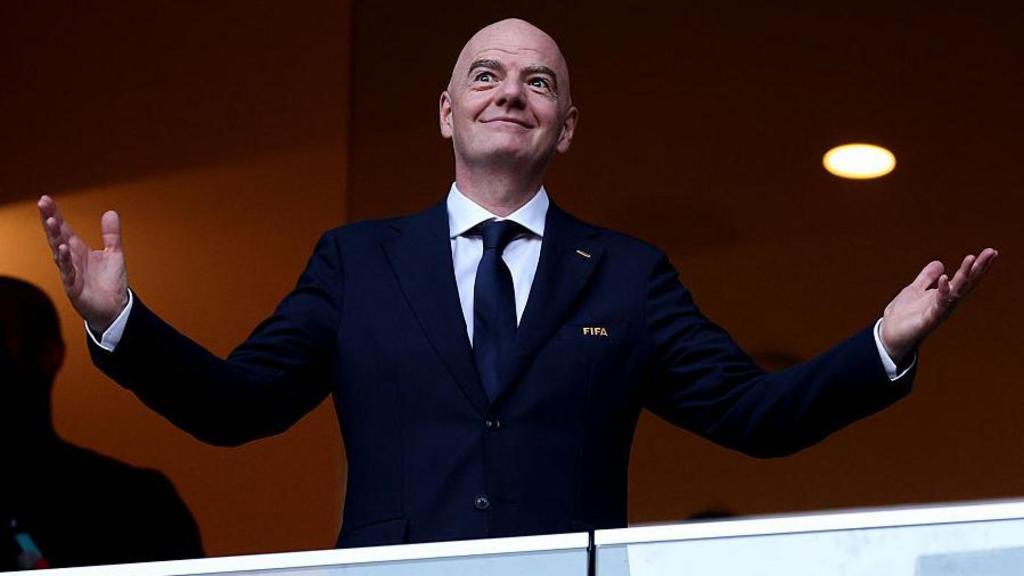
The 2026 FIFA World Cup in the United States, Canada, and Mexico is already the biggest in history with 48 teams. Now, FIFA president Gianni Infantino has opened the door to an even larger tournament — 64 teams.
What Infantino Said
In an interview with Swiss broadcaster Blue Sport, Infantino confirmed that FIFA will examine the possibility of expanding the World Cup to 64 teams after the current tournament wraps up.
“When organising a World Cup, it’s important to organise it for the whole world — not just Europe and South America, but effectively the entire world,” Infantino said. “Every nation should be allowed to dream of participating in the World Cup.”
The FIFA president argued that the quality of international football is rising everywhere, and that smaller nations need the incentive of a World Cup place to keep improving.
Why the 48-Team Format Is Considered a Success
Infantino pointed to the 2026 tournament as proof that expansion works. A key statistic he highlighted was the performance of African nations — nine out of 10 African teams progressed to the knockout stages, compared to just five African representatives at the 2022 World Cup in Qatar.
The expanded format has delivered more competitive matches, more global interest, and more representation from regions that previously had limited access to football’s biggest stage.
Who Proposed the 64-Team Idea?
The idea did not come from FIFA directly. South American governing body CONMEBOL officially proposed expanding the 2030 World Cup to 64 teams in April 2025. No decision has been reached, but Infantino’s public comments suggest the proposal is being taken seriously.
The 2030 World Cup will be mainly co-hosted by Spain, Portugal, and Morocco, with three opening matches held in Argentina, Uruguay, and Paraguay to celebrate the centenary of the competition. Uruguay hosted the very first World Cup in 1930.
Not Everyone Agrees
The proposal has faced strong opposition from some of football’s most powerful figures. UEFA president Aleksander Ceferin has called a 64-team World Cup a “bad idea,” arguing it would harm both the tournament’s quality and the qualifying process.
Asian Football Confederation president Sheikh Salman bin Ibrahim Al Khalifa went further, warning that further expansion would bring “chaos” to the international calendar.
Critics worry that a 64-team format would dilute the quality of matches, make the tournament too long, and place additional strain on players who already face a congested schedule at club and international level.
How the World Cup Has Grown Over Time
The World Cup has expanded several times throughout its history:
- 1930: 13 teams at the inaugural tournament in Uruguay
- 1934–1978: 16 teams (with some exceptions)
- 1982: Expanded to 24 teams in Spain
- 1998: Expanded to 32 teams in France
- 2026: Expanded to 48 teams in the US, Canada, and Mexico
- 2030?: 64 teams under discussion
Each expansion has brought new nations into the fold and generated debate about whether the tournament is growing too large.
What to Watch
The 2026 tournament will be the real test. If the 48-team format continues to deliver exciting matches and strong attendances, pressure will grow to go even bigger. If the quality drops or the schedule becomes unmanageable, the 64-team proposal may lose momentum.
A formal decision is expected after the 2026 World Cup concludes, with the 2030 tournament likely to be the first opportunity to implement any changes. Football fans around the world will be watching closely — both on the pitch and in the boardroom.