
The scale of travel
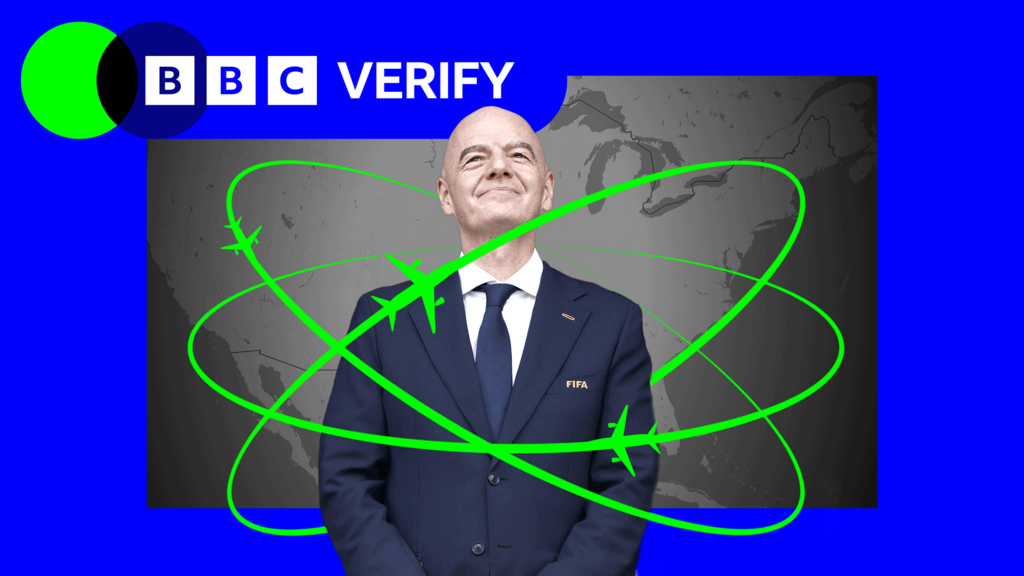
FIFA president Gianni Infantino has attended 24 matches in just over two weeks, traveling across three countries and 16 host cities by private jet.
BBC Verify and BBC Sport tracked a Qatar Airways Executive jet linked to Infantino, which took 27 flights during the group stage. The aircraft traveled at least 31,144 miles (50,122km) and spent more than 66 hours in the air.
The environmental impact
The estimated climate impact from this jet over a fortnight is roughly equivalent to the yearly emissions of 78 people.
The Gulfstream G650ER, the plane Infantino is believed to be using, has an average fuel burn rate of approximately 1,817 litres per hour. Based on UK government greenhouse gas conversions, the group stage travel produced an estimated 516 tonnes of carbon dioxide-equivalent (CO2e).
Private jets are typically five to 14 times more polluting than commercial planes and 50 times more than trains.
The longest journeys
The longest flight was 2,800 miles from Vancouver to Miami on 13 June. The shortest was 92 miles from Philadelphia to Teterboro Airport in New Jersey on 22 June.
On 15 June, Infantino flew more than 2,700 miles from Miami to Seattle for Belgium v Egypt, then traveled 960 miles south to Los Angeles for Iran v New Zealand in the evening.
FIFA’s response
FIFA said the president “routinely travels, together with relevant officials, on business and tournament-related matters.” They did not respond to questions about whether any flights were commercial, how many people traveled on the jet, or whether FIFA offsets these emissions.
FIFA has committed to reducing emissions by 50% by 2030 and reaching net-zero by 2040. For this World Cup, they pledged to host teams regionally to reduce long-haul travel.
The bigger picture
A 2025 report from Scientists for Global Responsibility estimated the overall carbon footprint of this World Cup could reach nine million tonnes of CO2e — almost double the average for the past four World Cups.
In 2023, a Swiss regulator said FIFA had “made false statements” by claiming Qatar 2022 would be the first carbon-neutral World Cup.
The contrast between FIFA’s sustainability pledges and the president’s travel habits highlights the gap between rhetoric and reality in football’s environmental commitments.