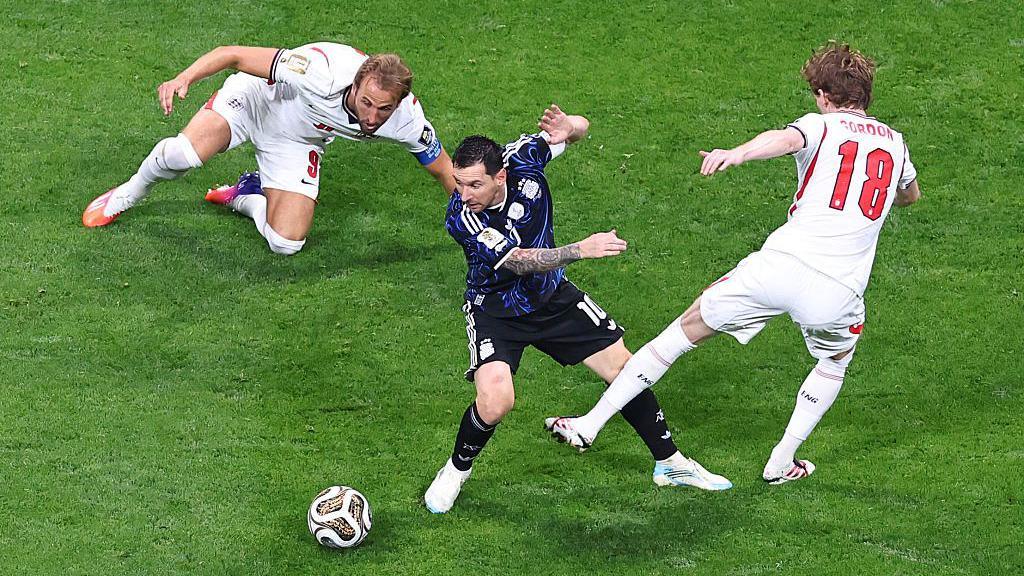
England came into the World Cup semi-final with a clear plan: use physicality and a high press to suffocate Argentina’s midfield. For 45 minutes, it worked. Then Lionel Messi decided it didn’t.
The 39-year-old dismantled England’s tactical structure piece by piece, setting up both goals in a stunning 2-1 comeback victory. Here’s how the greatest player of all-time served as Argentina’s on-field coach in Atlanta.
England’s Early Press Had Argentina Trapped
Thomas Tuchel set up England to press Argentina high. Wingers Anthony Gordon and Morgan Rogers pressed the Argentina centre-backs, angling their bodies to block passes to the full-backs. Harry Kane and the midfielders took a man-to-man approach centrally.
Jude Bellingham sat deeper than expected, tracking Enzo Fernandez. Declan Rice marked Alexis Mac Allister. Elliot Anderson was paired with Messi. The plan was simple: physically bully Argentina out of their preferred central passing game.
And it worked — for a while. Anderson was sharp in the first half, winning early duels and intercepting passes intended for Messi. England’s energy and aggression stifled Argentina’s rhythm.
Messi Dropped Deep and Changed the Game
As the first half progressed, Messi began taking deeper positions. This created a dilemma for Anderson: follow him and leave space behind, or hold position and let Messi receive freely?
Messi’s walking pace became his greatest weapon. From a near-standstill, he would suddenly burst into life, darting towards the ball. England’s defenders had to react to these unpredictable movements, and the advantage shifted to Argentina as England’s pressing energy faded.
By dropping deep, Messi helped Argentina bring the ball forward as a unit. He separated himself from England’s midfield markers, creating passing lanes that didn’t exist in the first half.
The Equaliser: Messi’s Gravity Pulls England Apart
After Anthony Gordon gave England the lead in the 55th minute, Tuchel’s side sat deep. Between Gordon’s goal and Argentina’s equaliser, England had just 12 per cent of possession.
Messi exploited this by leaving his central position entirely. Against England’s compact, centrally-focused defensive block, he drifted into empty space — either deep in front of England’s back line or wide on the right touchline.
For the equaliser in the 85th minute, Messi played a one-two from a short corner, then dribbled infield. Anderson left his central position to double up on him. Messi delayed his pass, drawing defenders towards him, then released Fernandez with acres of space. The Chelsea midfielder struck clinically past Jordan Pickford. 1-1.
Exploiting Bellingham’s Positioning
Throughout the match, Messi identified a flaw in England’s defensive structure: Bellingham’s tendency to stay high or drift towards the ball rather than covering the right flank.
In a 4-4-2 defensive block, the near-side striker should track back to help in wide areas. Bellingham often didn’t, leaving Messi free in the space behind him on Argentina’s right side.
This created dangerous overloads. With Messi and a teammate often in two-versus-two situations on the flank, Argentina could quickly turn it into three-versus-two when Bellingham failed to drop across. The result was a stream of dangerous crosses into the box.
Tuchel’s Tactical Tweaks Played Into Messi’s Hands
When Tuchel switched to a back five to match Argentina’s attackers in the box, it suited the game Messi wanted to play. England’s three central midfielders could no longer cover the full width of the pitch.
Messi recognised this instantly. He positioned himself outside England’s third central midfielder, holding space on the right where he could receive and create.
Later, when Rice was substituted and Bellingham dropped into an unfamiliar holding role, the problem worsened. Bellingham’s natural instinct was to drop deep, then make long sprints to close down Argentina’s midfielders. He couldn’t manage the vertical distances the way Rice could.
From this deep position, Bellingham couldn’t close down Fernandez, who had time to shoot from distance. That shot won the corner from which Argentina eventually built their winner.
The Stoppage-Time Winner: Scaloni and Messi Combined
Head coach Lionel Scaloni made bold attacking changes — introducing Nico Gonzalez and Lautaro Martinez for aerial presence, and Rodrigo de Paul out wide. Combined with flipping the roles of Fernandez and Mac Allister, Argentina suddenly threatened from every attack.
In the 92nd minute, Messi delivered the decisive cross. Lautaro Martinez, the substitute, rose to head home and send Argentina to their second consecutive World Cup final. Argentina 2, England 1.
What This Tells Us About Modern Football
Messi’s performance was a masterclass in footballing intelligence over physicality. At 39, he cannot press or sprint like he once did. But his ability to read space, manipulate defenders, and make decisions faster than anyone else on the pitch remains unmatched.
England had the energy, the structure, and the game plan. Messi had the football brain. In a World Cup semi-final, brain beat brawn.
Argentina now head to the final as defending champions, with Messi chasing a third consecutive World Cup title. After a performance like this, betting against him feels unwise.